ActZero · Phase 1 of 3 — Ambiguity
ActZero had real MDR technology and no public identity. This study covers the intervention that created market surface area — brand, narrative, and the marketing site that exited stealth. The customer portal ran in parallel; that work is Phase 2.
Context
I joined ActZero as Creative Director with one mandate: give a stealth-mode company a public identity before its funding timeline ran out. ActZero had acquired Intelligo, an AI-driven MDR company — endpoint telemetry, machine learning, 24/7 analyst operations. What it didn’t have was a name anyone knew, a brand, a website, or a market narrative.
The deliverables were interdependent. The marketing website was the exit from stealth, but it couldn’t ship without a brand system to build on, and the brand system couldn’t be meaningful without a product narrative to anchor it. All three had to move together.
Insight
The category defaulted to fear-forward aesthetics. ActZero's product story was proactive protection — the visual and verbal language were misaligned before we started.
Hypothesis
Narrative-first sequencing would let vendors and in-house teams execute in parallel without creative bottlenecks or positioning drift.
Decision
Anchored the system on "Reacting Isn't Enough" — identity tokens derived from that hook, not the reverse.
Building the Brand System
The brief was specific: feel like a technology company that took security seriously, but not like a traditional enterprise security vendor. ActZero’s positioning was about speed, confidence, and active protection — security that feels like you’re ahead, not behind.
The identity system centered on a teal and lime palette — deep teal for trust and expertise, electric lime for speed and action. Poppins and Rubik as the type pairing: headline authority and body legibility at scale. The logomark — a stylized “A” within a circle — carried enterprise credibility and a sense of motion.
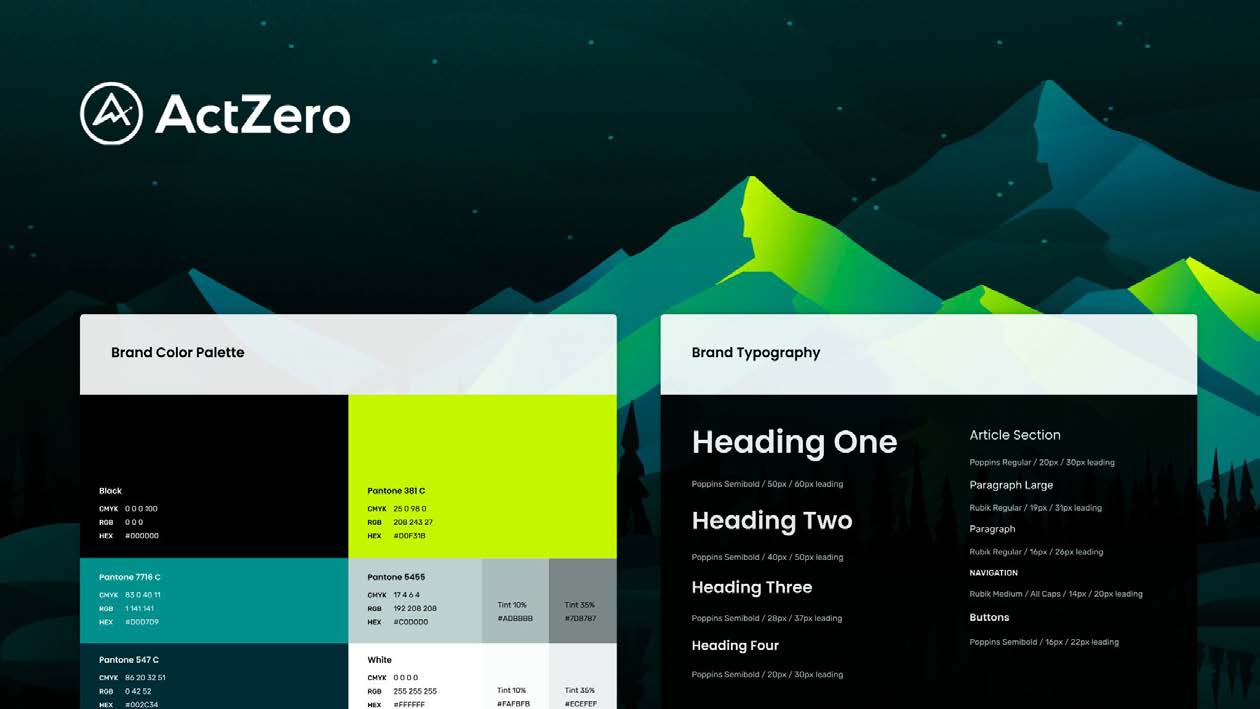
I directed development across in-house designers and external vendors — setting creative standards, reviewing against the brief, and ensuring consistency from the website through sales decks to the product interface.
Product Narrative and Website
The hardest part wasn’t the design — it was the story. MDR is a category with a credibility problem: every vendor claims 24/7 coverage, faster detection, fewer false positives. The narrative needed to cut through that sameness with something honest and specific.
Reacting Isn’t Enough challenged the reactive security posture most SMB and mid-market organizations were running. The supporting story connected that problem to ActZero’s actual model: AI-accelerated threat detection with human analyst expertise, built for companies that couldn’t staff an in-house SOC.
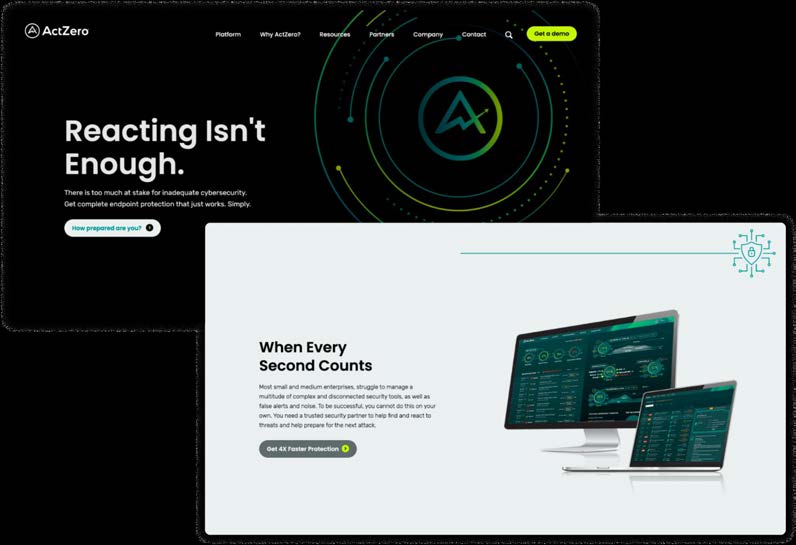
The website shipped as ActZero’s primary public presence — brand-coherent, conversion-ready, and the visual standard for every customer-facing surface that followed. The brand tokens established here became the shared layer the customer portal implemented against.
GTM Enablement
With identity and narrative in place, the in-house marketing team could run campaigns, build collateral, and produce event materials without creative direction on every asset. The system was designed to scale without me as a bottleneck.
That coherence showed up in the numbers. Clear positioning and a website that converted interest into demo requests contributed to 28% ARR expansion over the period. The end-to-end experience from first touchpoint through onboarding earned a 4.8/5 CSAT — a signal that what prospects saw in the brand matched what they experienced in the product.